Аукционы

Подлинность работ на ряде аукционов не подтверждена. Возможны подделки.

Auktionshaus Dr. Fischer
200. Jubiläumsauktion - 200 Meisterwerke
Samstag, 24. September 2011
Lot 141
Cloisonné-Email-Dose
Katalogpreis: 12.000 - 15.000 €
Zuschlag: 28.000,00 EUR
Samstag, 24. September 2011
Lot 141
Cloisonné-Email-Dose
Katalogpreis: 12.000 - 15.000 €
Zuschlag: 28.000,00 EUR
Silber, vergoldet. Im Querschnitt ovale Wandung flächenfüllend mit geometrischen Motiven und stilisierten Blüten in polychromem, fein schattiertem Cloisonné-Email dekoriert. Auf dem Scharnierdeckel polygonales Bildfeld in Plein-Email. Auf der Bodenunterseite und im Deckel punziert mit Marke der Moskauer Bezirksbeschauadministration, Feingehalt ''88'' und Meisterzeichen ''FR''. L. 5,5 cm Provenienz: Christie's London, 12. Dezember 2000, Lot 182.
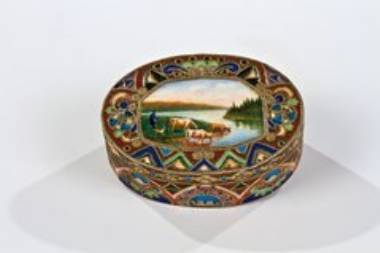
Deutsche Privatsammlung Objekte mit Cloisonné-Email hatten in Russland eine sehr lange Tradition und waren bei der Moskauer Kundschaft sehr populär. Die russischen Künstler des 19. Jahrhunderts ließen die Tradition des 16. und 17. Jahrhunderts wieder aufleben. Der in Moskau geborene Fedor Rückert betrieb eine eigene Werkstätte und fertigte ab 1887 Arbeiten für Fabergé. Im Gegensatz zu anderen Moskauer Meistern besticht die Qualität der Rückert`schen Objekte durch ihre ganz eigene Farbgestaltung sowie die ornamentale Verwendung der Silberdrähte, die zu Schnecken geformt sind. Rückert war einer der bedeutendsten Meister für Emailarbeiten, für die die pastelligen Farbnuancen sowie die gerundeten, geometrischen Motive charakteristisch sind. Das Motiv auf dem Deckel könnte auf eine Vorlage von Iwan Iwanowitsch Schischkin zurückgehen. Landschaftsgemälde mit Kühen sind für sein Werk belegt und waren für ihn Ausdruck des beschaulichen Landlebens in all seiner Einfachheit. Russian artwork has surpassed all cultures around the world throughout history when it comes to handcrafting silver with fine enamel inlay work of the exquisite work is reflected in the silversmith's art work. The legacy of Russian artist and silversmiths has been carried over more than two hundred years, with elegant brightly colored enamel work done against the metallic shine of silver. The interesting art of enameling on metals could be traced back to the era of the 16th and 17th century in Russia. The peak period in the history of Russian art was highlighted by the development of Cloisonné technique that was related to the craft of overlaying of enamel. Fedor Rückert was one of the famous silversmiths in Moscow producing cloisonné enamel. Rückert supplied Faberge with most of his enamels in the Russian style. His association with Faberge can be dated from 1887, when the Moscow workshop opened, to 1912, when a cup was produced to celebrate his twenty-five years with Faberge. Rückert employed a palette of dark blues, greens, greys and browns and pastel shades. He had developed intricate wirework patterns. Filigree wires no longer separate colours but begin to form patterns of their own. Typical are the geometric patterns of enamel. The miniature on the cover is probably a copy of a painting by Ivan Ivanovitch Shishkin. Similar landscapes showing cows are known in his oeuvre. For Shishkin they were examples for the generalised image of the countryside, the nature in all its simplicity. Literatur: G. v. Habsburg: Faberge. Hofjuwelier der Zaren, München 1986, 88-89.
Moskau, Fedor Rückert, 1908-1917